
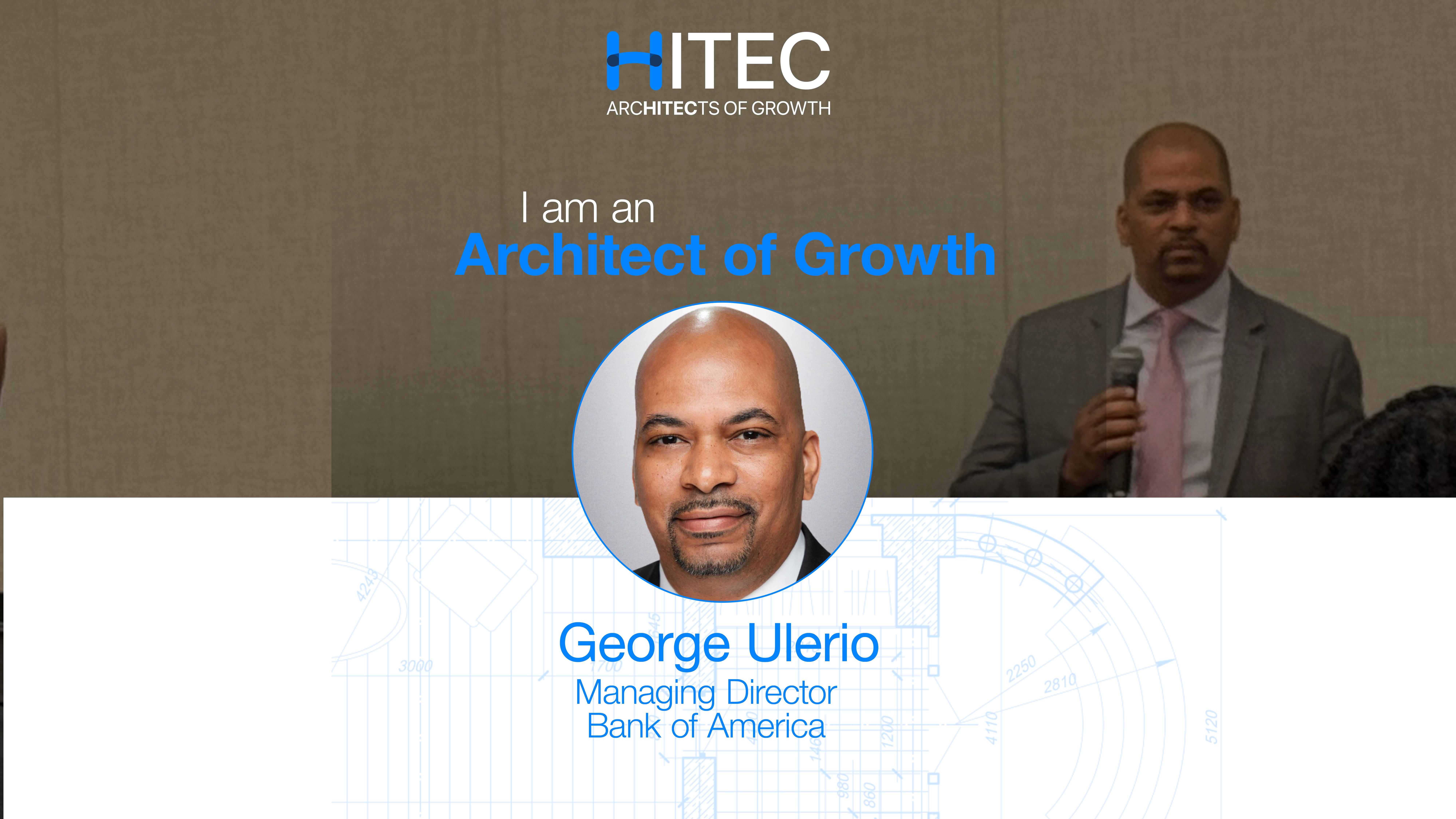
Fearless by Design: George Ulerio on Opportunity, Innovation, and Owning Your Path
"I Am an Architect of Growth" is a series spotlighting changemakers in the technology industry who are driving innovation and championing inclusion - in their own words.
When George Ulerio, Managing Director at Bank of America, talks about his career, there’s no script, no formula, and no straight ladder from bottom to top. Instead, there’s movement, risk, and perspective along with an unwavering belief in saying yes to opportunity.
With more than two decades of experience leading executive and enterprise technology support at global financial institutions including Citigroup, JPMorgan Chase, and now Bank of America, George’s journey is both unconventional and deeply intentional.
At the heart of it all are four words that define his blueprint: “Opportunity does not care.”
From a Cracked-Open Computer to Corporate Leadership
George’s career began with a single moment of clarity.
As a high school student without a computer at home, he watched a technician open one up in class.
“My mind was blown. I knew in that moment that’s what I wanted to do for a living.”
Despite being in the top 10% of his class, with academic and athletic scholarships within reach, George made a contrarian decision: he chose another path attending a trade school and entered the workforce at 19 where he worked alongside professionals with mortgages and children older than him. That accelerated maturity shaped him early.
His first role? Replacing routers on ATMs as a contractor for Bell Atlantic Network Integration for Summit Bank. That regional bank would later be acquired and eventually become part of Bank of America, where George now leads.
“My career kind of started as a predecessor to Bank of America and now I’m at Bank of America. It’s come full circle.”
The Financial Services Arena—and the Energy of New York
After a brief stint in pharmaceuticals, George followed his ambition to New York City in 1996.
“I really like the pace of financial companies, the pace of New York City. Once I started working here, I never turned back.”
Nearly 30 years later, he continues to thrive in the fast-paced environment of global financial services, leading executive support, trading support operations, technology cafés (similar to Apple Genius Bars), and regional teams across Latin America and Canada.
Inclusion as Strategy—Not Slogan
For George, opportunity and inclusion aren’t abstract ideals but strategic imperatives shaped by lived experience.
He recalls noticing that many corporate offices didn’t reflect the surrounding communities. That observation stayed with him.
“Inclusion and opportunity go hand-in-hand. It doesn’t mean lowering standards. It just means providing the same opportunity and letting the talent rise.”
Throughout his leadership journey, George has provided insight on recruiting strategies, expanded school outreach, and actively supported programs like NPower and YearUp, organizations that provide career pathways for young adults who take unconventional routes, much like he did.
He is also passionate about generational inclusion: “For a long time, I was the young person at work. I know what it’s like for people to discount your opinion because you look young.”
His leadership philosophy is clear: diverse perspectives create healthy debate—and healthy debate creates better decisions.
Innovation Is a Discipline, Not a Gift
George rejects the myth that innovation belongs to a select few.
“Innovation is a process. It’s not something only certain people are born with.” His approach? Persistent re-evaluation. Revisit prior work, re-examine it under new conditions, and go back for what was left on the table.
“You’ll be amazed how often you complete something and leave something behind. Go back and pick it up.” For George, innovation is not about flashy ideas—it’s about consistency, discipline, and refusing complacency.
The Caretaker Mindset
One of George’s most powerful reframes is how he views leadership roles. “I like to think about it as I am a caretaker. Someone had this role before me. Someone will have it after me.”
This perspective shifts focus from ownership to stewardship. His responsibility is to improve the function, align it with enterprise strategy, develop talent, and leave it stronger than he found it.
“At some point, you’ll turn the reins over—hopefully to someone you’ve developed.” It’s legacy thinking without ego.
Your Personal Board of Directors
When asked about personal challenges, George didn’t cite failure or adversity in isolation. Instead, he highlighted the importance of trusted relationships. He built, often unconsciously, a tight network of leaders and mentors from early in his career. “It’s like your personal board of directors.” These relationships were never transactional. They were built on genuine curiosity, care, and long-term trust.
“They don’t tell me what to do. They tell me what to consider.” That distinction—guidance without control—helped him navigate vulnerability, new roles, and moments of doubt.
Impact Beyond the Office
George speaks with pride about working for an organization that uses its influence intentionally. “This company has a powerful voice, and it uses that voice thoughtfully.”
He is particularly passionate about Bank of America’s Better Money Habits program, which provides financial literacy education to students and community members. “It’s not about how much money you make. It’s how you manage it.” For first-generation students and young professionals, those lessons can be life changing.”
The Donkey Kong Metaphor: Why You Must Say Yes
To explain his philosophy, George uses an unexpected metaphor: the classic video game Donkey Kong. In the game, there is no single ladder from bottom to top. Players navigate sideways, climb partial ladders, face risks like rolling barrels, and take opportunities when they appear. The white spaces represent opportunities. The red barrels represent risks. And progress often happens laterally.
“Even if you stay at the same level and move left to right, you’re still higher than where you started. That’s learning.” His perspective is simple: when an opportunity arrives, lean in and trust yourself to navigate it successfully, as:
Opportunity doesn’t pause for life’s timing.
It doesn’t wait until things feel perfectly aligned.
It doesn’t adjust to our readiness.
“You’re going to get your fair share of opportunities. It’s about what you do with them.”
George’s advice? Err on the side of yes. Believe in yourself. Trust those who see potential in you even when you don’t yet see it yourself.
“Sometimes people see something in you that you don’t see. You have to trust that.”
You Are Not Behind
Perhaps his most reassuring insight is this: “You’re not behind. You’re not ahead.You’re exactly where you’re supposed to be.”
Comparison is constant. There will always be someone wealthier, faster, higher ranked.
The real question is simpler: “How do you feel about what you’ve accomplished?” Your journey is not a race against someone else’s résumé. It’s an alignment between your values, your family, your ambition, and your growth. And sometimes, all you need is a catalyst to recognize that.
The Takeaway
George Ulerio’s career is not a story of linear ascent. It is a story of courage, stewardship, and disciplined growth. He opted for a different path.
He chose trade school over scholarships.
He embraced lateral moves as progress.
He built inclusion into strategy.
He revisits problems until they yield insight.
He says yes—even when it’s uncomfortable.
And above all, he reminds us: Opportunity does not always align perfectly with life’s timing; pay attention and lean in when your opportunities arrive.


